Pick a crate your dog can stand, turn and lie down in
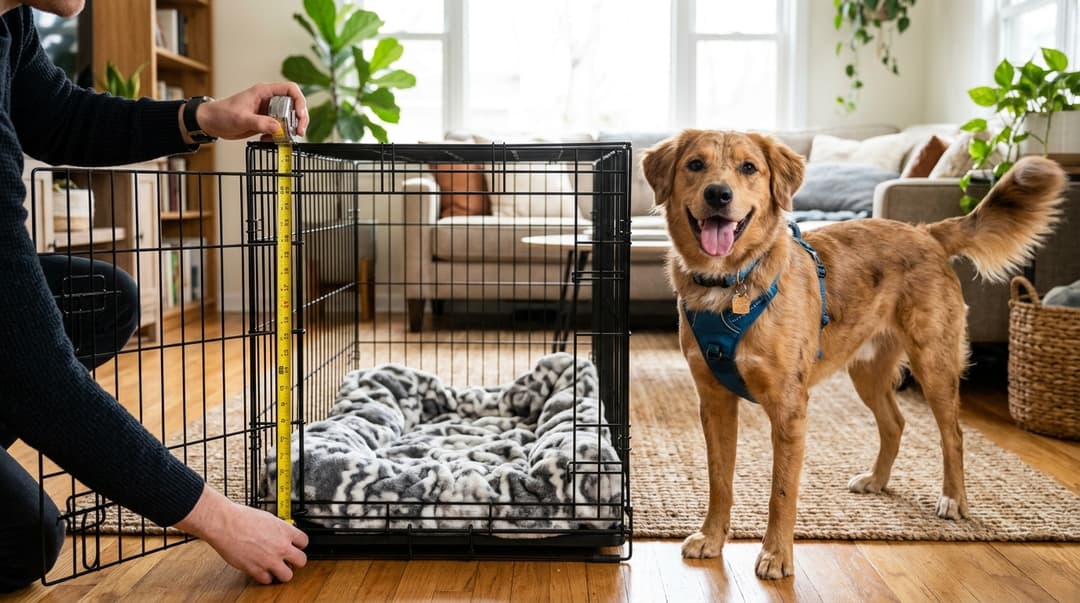
A crate should be big enough for your dog to stand up without ducking, turn around in, and lie stretched out on one side. It should not be so large that a puppy can use one end as a toilet. That is why the calculator uses two standards: AKC-style guidance for home crates, and IATA Container Requirement 1 for airline travel. The two are different, and a crate that works in the living room may not pass an airline check.
Enter your dog's measurements, nose to base of tail and height to the top of the head, and choose home or airline use. The result gives a suggested crate size. Puppies grow quickly, so plan for the adult size and use a divider while the puppy is small.
Worked example: a home crate
Suppose your dog measures 24 inches from nose to base of tail and 18 inches high at the top of the head. For a home crate, add about 3 to 4 inches to each measurement. That gives an interior of roughly 27 to 28 inches long and 21 to 22 inches high. A crate with those internal dimensions gives the dog room to stretch out and turn, without much spare space to use as a toilet area.
Check the crate's listed interior dimensions, not the outside measurements. Many crates lose several inches to walls and trays, and the advertised size is often the outer frame.
Worked example: an airline crate
For an airline crate, the IATA formula uses four measurements: A, the nose to base of tail; B, the shoulder to base of tail; C, the chest width; and D, the height from the floor to the top of the ears when standing. The internal length is A plus half of B. The internal width is twice C. The internal height is D plus room for bedding.
Take a dog with A = 24 in, B = 16 in, C = 10 in and D = 18 in. The internal length is 24 + 8 = 32 in. The internal width is 20 in. The internal height is 18 in plus bedding, so about 20 to 21 in. Snub-nosed breeds need about 10% extra room because of breathing risk in the hold, so this dog would need slightly more space if it were a bulldog or pug.
Always confirm your airline's current kennel rules before you book. Airlines can set stricter limits than the IATA formula, and a crate that is legal on one airline can be refused by another. For trip planning, the Travel Estimator can help you think through costs and logistics.
Home crate sizing in detail
For a home crate, measure your dog from the tip of the nose to the base of the tail, and measure height from the floor to the top of the head while the dog stands. Add about 3 to 4 inches to both measurements. That room lets the dog stretch and turn. A crate much bigger than this is harder to keep clean, and it can encourage a dog to use one corner as a toilet.
If your dog is between sizes, go with the larger crate and use a divider panel. A puppy's crate should be sized for the adult the puppy will become, with a divider to limit space while the puppy is small. Remove the divider in stages as the puppy grows, and check the fit every few weeks during the first year.
Crate sizes by weight: a rough guide
Weight alone does not decide crate size. A long, low Dachshund and a tall, lean Greyhound can weigh the same and need very different crates. Use weight only as a starting point, then check the measurements.
Typical adult weight
Common crate size
Notes
Under 10 lb
Extra small
Check height for tall toy breeds
10 to 25 lb
Small
Watch length on long-bodied dogs
25 to 50 lb
Medium
Measure before buying
50 to 70 lb
Large
Airline crates often need extra care
Over 70 lb
Extra large
Check the airline's maximum
How to measure your dog for a crate
Have your dog stand naturally, not crouching or stretching.
Measure from the tip of the nose to the base of the tail, along the back.
Measure height from the floor to the top of the head or ears.
Write both down and add 3 to 4 inches for a home crate.
For a flight, also measure the shoulder to base of tail and the chest width, and note the height to the ears.
Measure twice. A tape that sags or a dog that slouches can give a reading that is an inch or two off.
Airline crates: what else to check
Ventilation: airline crates need openings on several sides, as required by the airline.
Water and food dishes: many airlines want dishes attached to the door, with feeding instructions stated on the crate.
Labels: live animal labels and your contact details should be attached clearly.
Floor and bedding: a thin layer of absorbent bedding, not thick padding that can make the dog overheat.
Test the fit: the dog should stand, turn and lie down in the crate before the flight, and you should practise with it at home.
Crate sizing is not crate training
This page is about the size of the crate. For how to introduce a crate, use a routine and build a positive association, look for a crate-training guide before you start. Sizing and training are separate decisions, and the best size is only useful if the dog learns to settle in it.
Measure your dog's length from nose to base of tail and height from the floor to the top of the head. Add about 3 to 4 inches to each measurement for a home crate. The dog should stand, turn around and lie down in the crate without touching the top or sides, and the crate should not be so large that the dog can use one end as a toilet.